Origin · 2018 → 2026

Where the Institute comes from.

Eight years of gatherings, publications, conversations and shared inquiry. Not a history — the soil. The Institute is what has grown from it.

01 — The shape of the work

Emerge was founded in 2018 by three non-profit organisations — the Ekskäret Foundation in Stockholm, Perspectiva in London, and Co-Creation Loft in Berlin — to ask, openly and in public, what was emerging at the edges of philosophy, contemplative practice, systems thinking and cultural renewal. Four gatherings followed across Berlin, Kyiv and Austin, drawing together pioneers in the fields converging on the meta-crisis. Alongside them grew a media platform, a podcast, and a sister relationship with the Inner Development Goals.

What was built was less an organisation than a field — held together by shared seriousness rather than shared doctrine. The Emerge Institute is what that field has now become: a place where the work of the last eight years takes institutional form, and where the question that animated all of it can be carried deeper.

02 — The gatherings · four moments
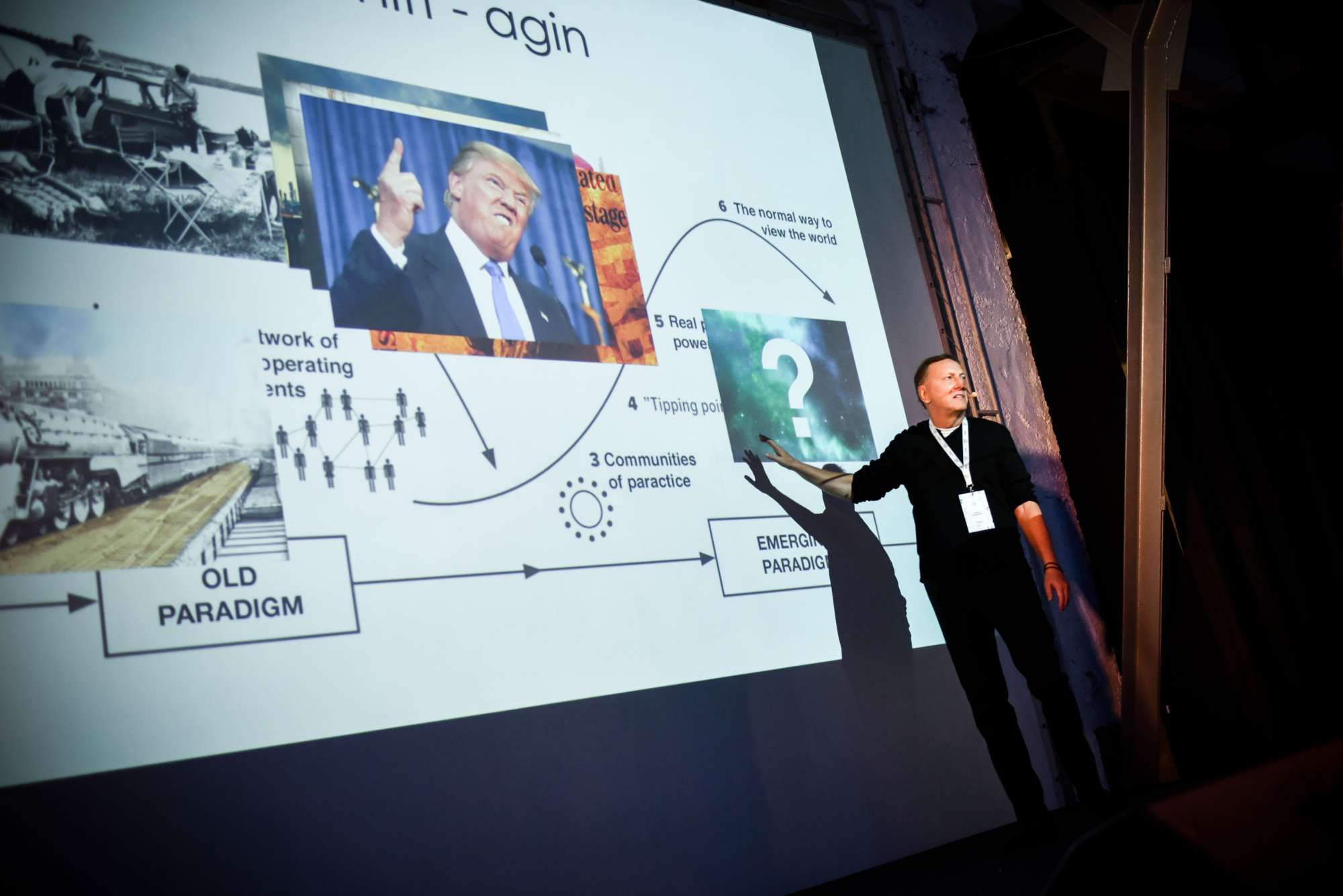
Berlin 2018 — Jonathan Rowson presenting the Perspectiva Press and Spiritualise titles on stage.
Berlin · 2018Jonathan Rowson · Perspectiva
i 2018 Berlin · November

The first gathering — on the anniversary of the Wall.

≈ 100 participants Kreuzberg & Neukölln 9–11 November

Three non-profits — Ekskäret Foundation, Co-Creation Loft, Perspectiva — convening pioneers in complexity, philosophy, spirituality, psychology and sustainability. The whatisemerging.com platform launched the same weekend.

Daniel Görtz · Jonathan Rowson · Lene Rachel Andersen · Indra Adnan · Erik Fernholm · Joana Breidenbach · Bettina Rollow · Caroline Stiernstedt Sahlborn · Alexander Björkman · Pamela von Sabljar · Tomas Björkman.

+Read full accountRead less

Around 100 people came to Berlin over the weekend of 9–11 November 2018, on the anniversary of the fall of the Wall — a date that carries in Germany a particular weight of historical rupture and possibility. The venues were spread across Kreuzberg and Neukölln: the FvF Friends Space on Glogauer Strasse, the cocreation.loft on Schinkestr., and Klunkerkranich, an improbable rooftop bar above the Neukölln Arcaden.

In his welcome, Tomas Björkman offered the framing image that would carry through all subsequent gatherings: participants are like the blind people trying to describe the elephant — each understanding something true but partial. The gathering existed to deepen each person's work and to begin connecting the parts, not to produce a unified vision but to start discerning the contours of what was emerging.

Friday gave way to workshops — eighteen sessions across three time slots. Daniel Görtz on metamodern theory. Jonathan Rowson on spiritual sensibility and a metamodern reader for the new Perspectiva Press. Lene Rachel Andersen on 21st-century Bildung. Erik Fernholm on tech for personal growth at scale. Caroline Stiernstedt Sahlborn on deliberately developmental spaces — Ekskäret Island, K9 co-living, the cocreation.loft — as prototypes the network might learn from. Alexander Björkman ran what would turn out to be a significant session: a metamodern college or monastery in Kyiv, a seed that bore fruit the following year.

Berlin 2018 was small, exploratory and deliberately unfinished. That was the point. It was the beginning of something none of the people in the room could yet see whole.

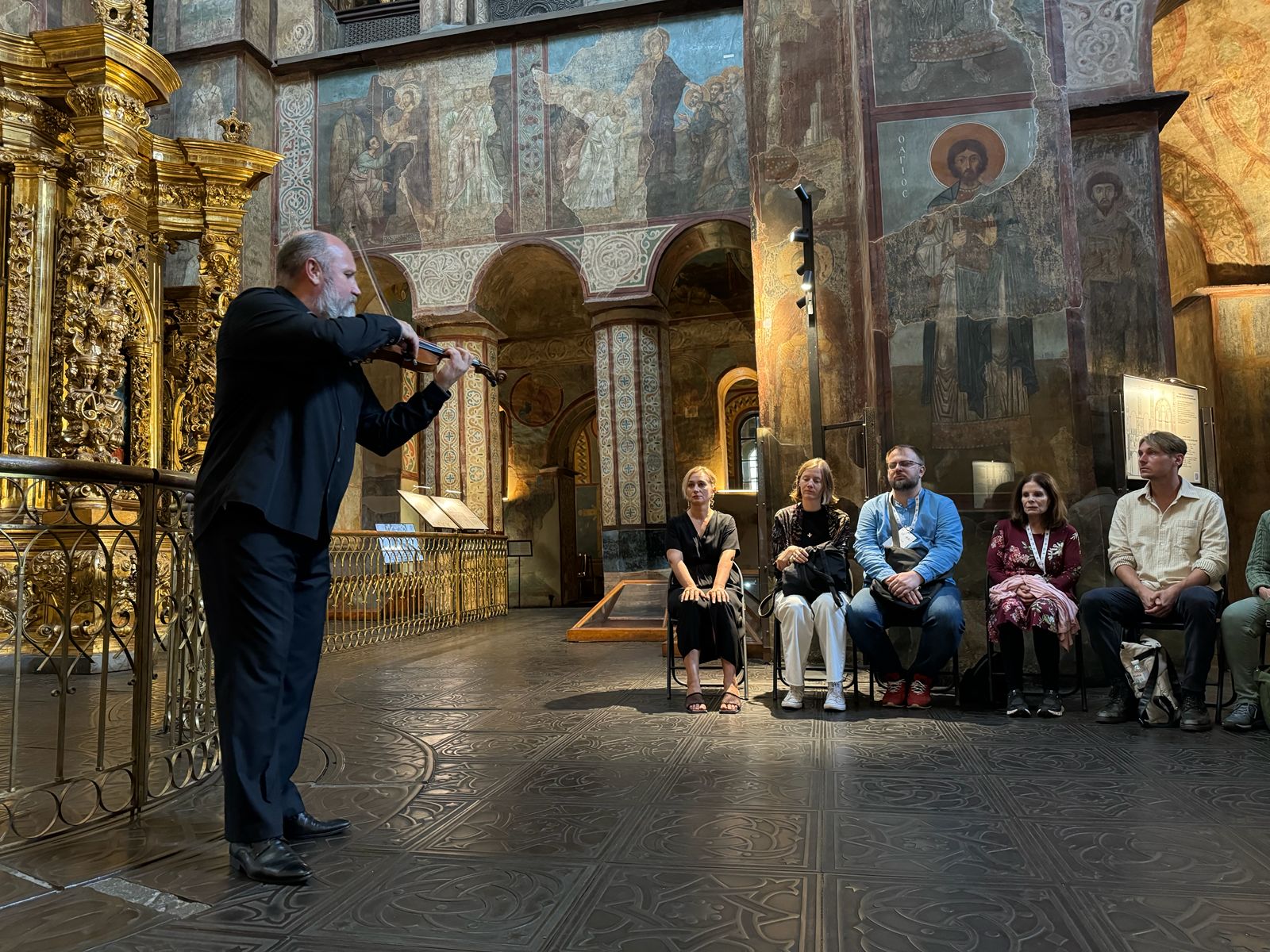
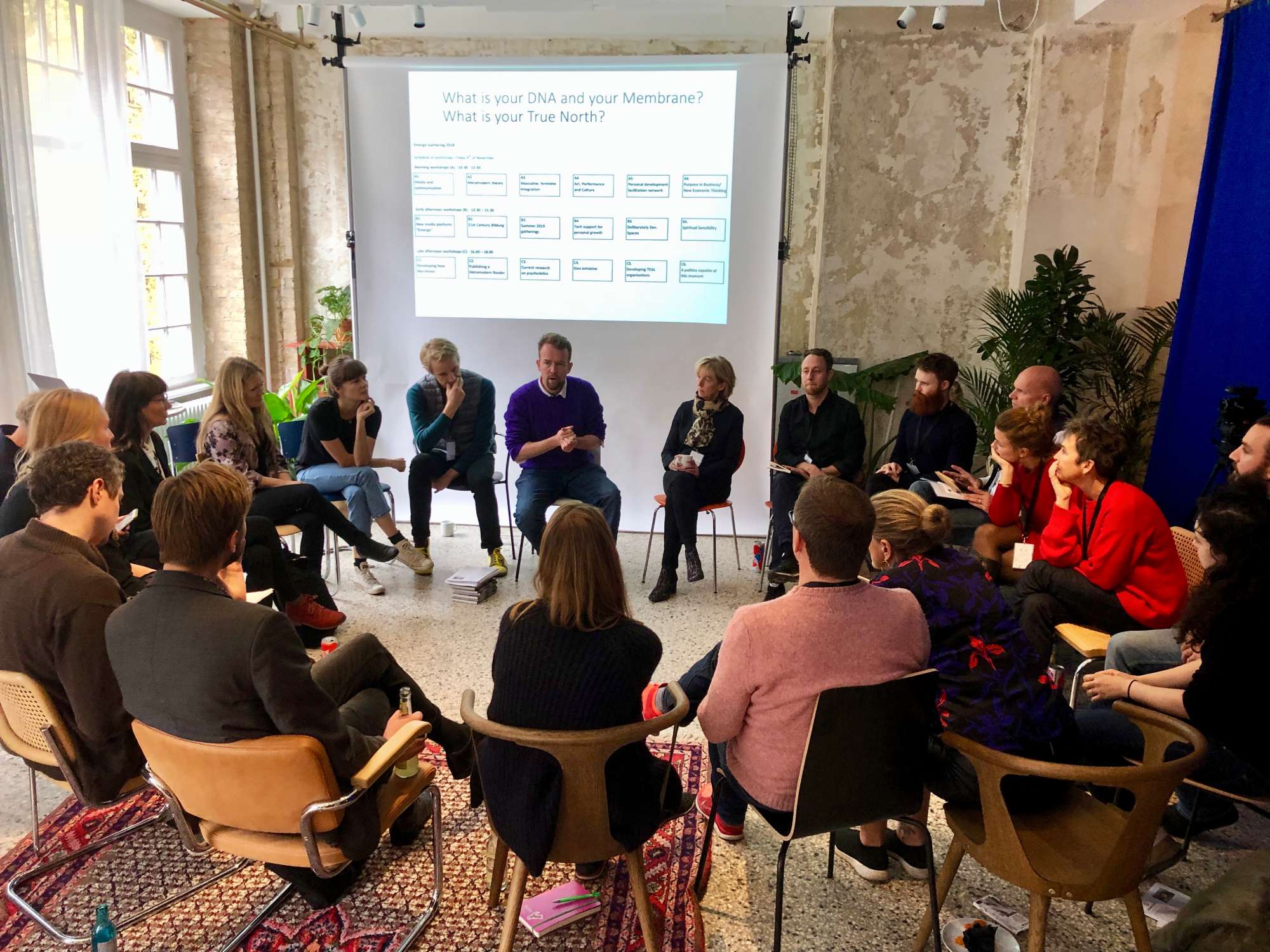
Kyiv 2019 — a workshop circle at IZOLYATSIA, with the prompt 'What is your DNA and your Membrane? What is your True North?' projected behind.
Kyiv · 2019IZOLYATSIA workshop
ii 2019 Kyiv · September

The frontier land.

≈ 180 participants IZOLYATSIA · Dnipro riverbank 27–29 September

A converted industrial space on the Dnipro, a city still living the aftershocks of the 2014 Revolution of Dignity. One of the last large European gatherings of its kind before the pandemic changed everything.

Elizabeth Debold · Thomas Steininger · David Fuller · Maria Clara Parente · Jan Artem Henriksson · Daniel Görtz · Elke Fein · Daniel Thorson · Joana Breidenbach · Halea Isabelle Kala.

+Read full accountRead less

The second Emerge Gathering took place across the weekend of 27–29 September 2019, at the IZOLYATSIA Platform for Cultural Initiatives — a former industrial space on the banks of the Dnipro that had become one of Ukraine's most vital centres for contemporary art and civic culture. The choice of city was deliberate. "Kyiv is in many ways a frontier land," Tomas Björkman said in his opening. "Systems change always starts at the periphery, not in the centre, of a system."

The three founding organisations gathered their growing European network around the question that had animated the project from the beginning: what is emerging? Björkman's introduction offered the clearest statement yet of the intellectual framework — EMERGE as an acronym spanning Enquiry, Method, Epoch, Reckoning, Games and Ethos.

Sixteen Friday sessions ran in two parallel sets, from Integral and Metamodern Philosophy to Deliberately Developmental Spaces, from a politics capable of the moment to the Bildung tradition in Ukraine and the Balkans. Saturday turned inward: Elizabeth Debold and Thomas Steininger led the main hall through an emergent dialogue process they had been developing for two decades — a room of a hundred people arriving at something that felt like shared grief and shared stillness.

The evening brought the Metamodern Arts Festival, curated by Halea Isabelle Kala, including the Glass Bead Game inspired by Hermann Hesse. Kyiv 2019 stands, in retrospect, as the moment the network was most simply and openly itself: curious, experimental, and genuinely uncertain about where it was going.

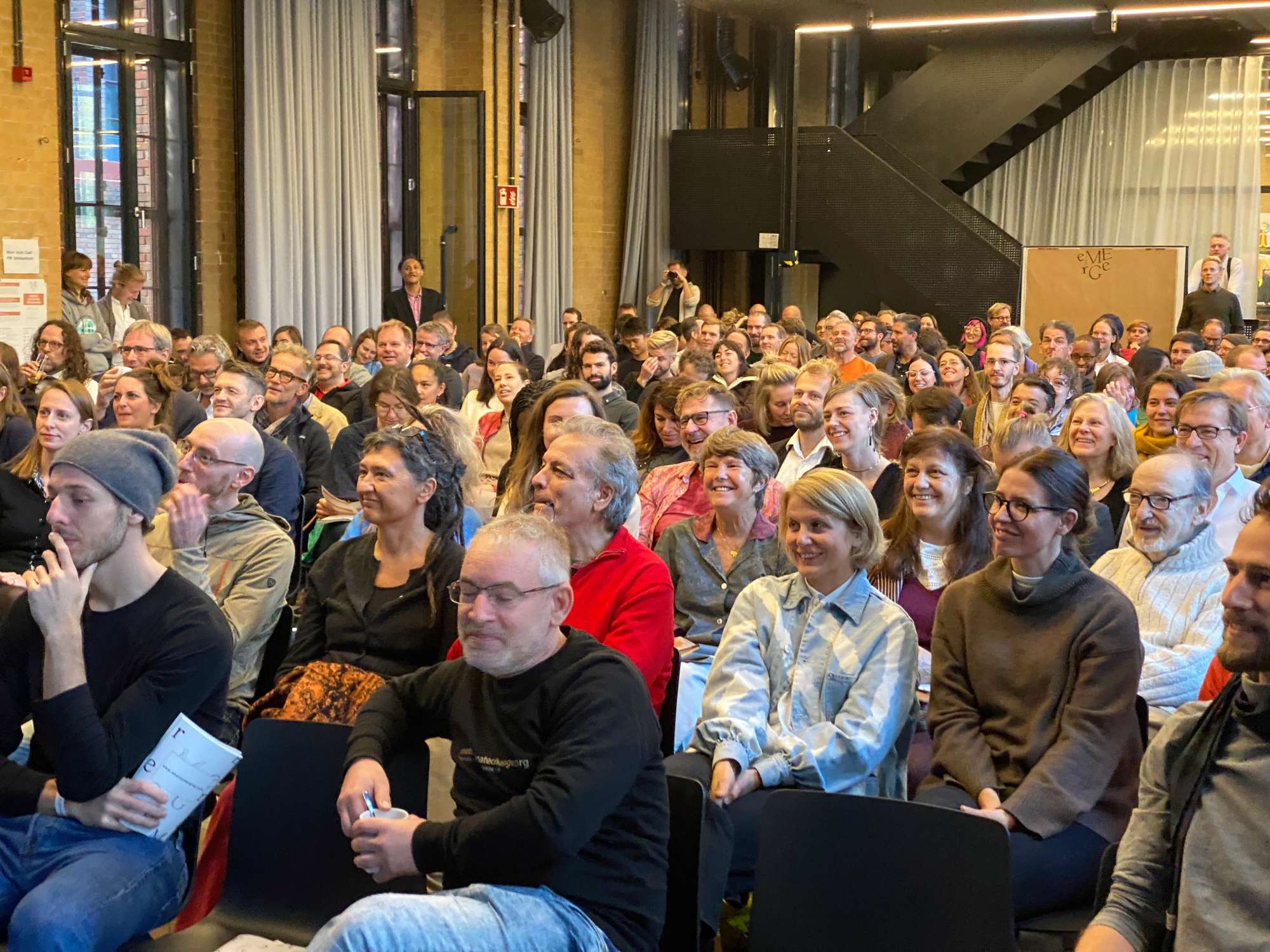
Berlin 2021 — a full audience at bUm in Kreuzberg, the Emerge wordmark visible on the back wall.
Berlin · 2021bUm · Kreuzberg
iii 2021 Berlin · October

Returning in person — and the question of an 'impossible we'.

≈ 250 participants bUm · Kreuzberg 9–10 October

The first in-person gathering since Kyiv. Two days at bUm in Kreuzberg, holding the question of a coherent collective we across three registers: imagination, presencing, and practical innovation.

John Vervaeke · Elizabeth Debold · Phoebe Tickell · Indra Adnan · Anthea Lawson · Indy Johar · Jamie Bristow · Mariana Bozesan · David Fuller · Jan Artem Henriksson · Joana Breidenbach.

+Read full accountRead less

Around 250 people came to Berlin across the weekend of 9–10 October 2021, with an informal welcome the evening before. The pandemic had intervened. The world had shifted. And the question that had always animated Emerge — how do we form a 'we' capable of responding to what we are facing? — had become both more urgent and harder to answer.

The gathering was arranged by Perspectiva and supported by the Berlin Senate's department for economics and enterprise. It was produced by Anna Katharina Schaffner, and organised jointly with Ivo Juriaan Mensch, Tomas Björkman and Jonathan Rowson. The facilitation core — Indra Adnan, Elizabeth Debold, Pamela von Sabljar, Thomas Steininger and Phoebe Tickell — shaped two days at the bUm space in Kreuzberg.

The intellectual framing had sharpened. The welcome text named the paradox directly: a bigger we is regularly called upon to address our burning global challenges, yet even the climate crisis has not brought us closer together. The social change space is no less fragmented than anywhere else — people married to their own theories of change, their brands, their niches. Is the dream of a coherent collective agency simply a dream? The gathering did not resolve that question. It held it.

The gathering generated a cluster of essays — Jonathan Rowson's 'The Impossible We?', Anna Katharina Schaffner's 'Can Emergence Be Our Saving Grace?' and Phoebe Tickell's 'Moral Imaginations'. Berlin 2021 marked the moment the field began to take stock of what it had built — and what it still needed to become.

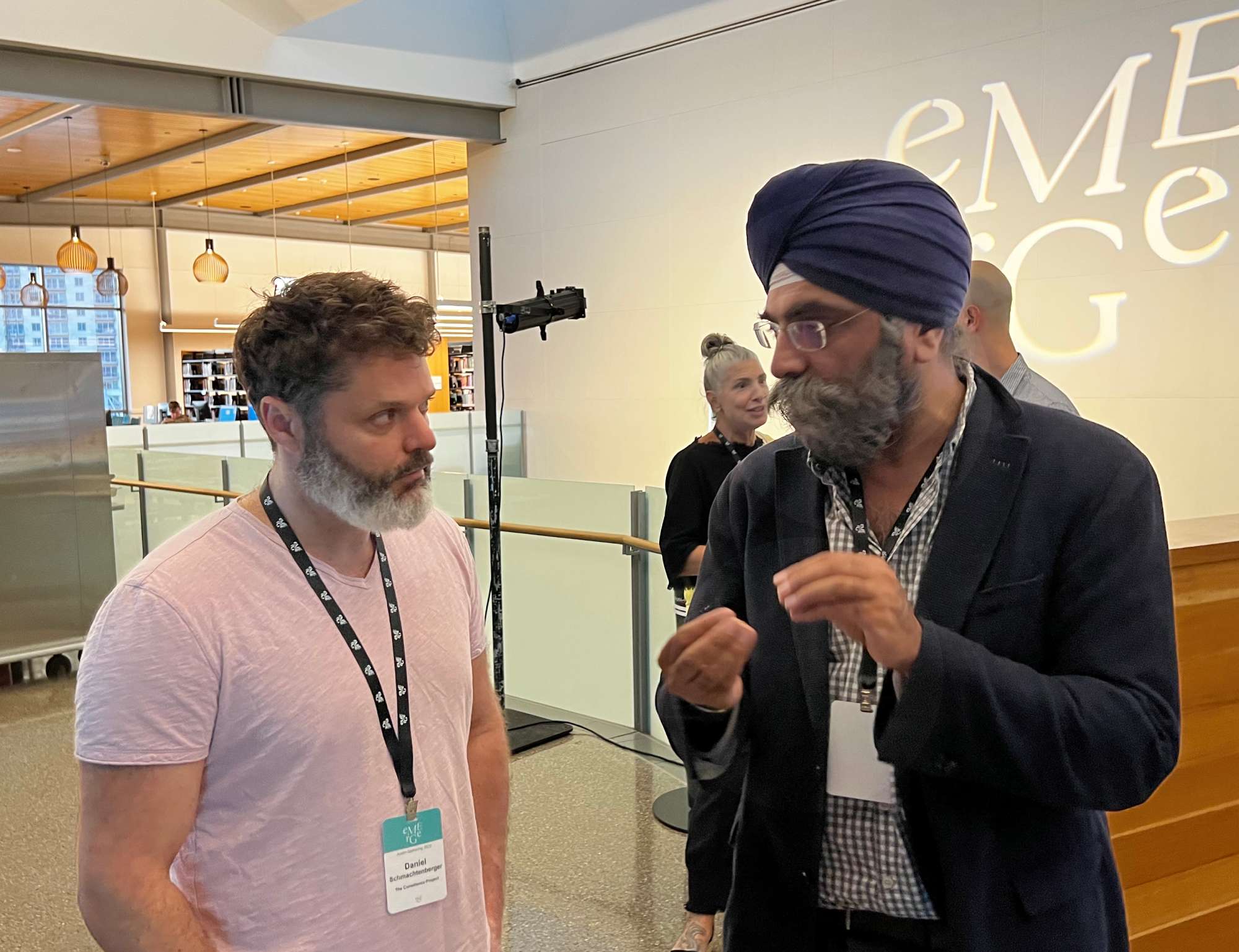
Austin 2022 — Daniel Schmachtenberger and Indy Johar in conversation at the Austin Central Library, the Emerge wordmark on the wall behind them.
Austin · 2022Daniel Schmachtenberger · Indy Johar
iv 2022 Austin · June

Emerge crosses the Atlantic.

≈ 160 participants Austin Central Library Late June

A weekend in the event space of Austin's Central Library — depth over breadth. The gathering named honestly what the network risked becoming, and asked what it would take to be genuinely useful beyond its own boundaries. Field-creation, not just field-finding.

Daniel Schmachtenberger · Tristan Harris · John Vervaeke · Charles Eisenstein · Jeremy Lent · Nate Hagens · Jamie Wheal · Roger Walsh · David Sloan Wilson · Liv Boeree · Indy Johar · Joe Edelman · Layman Pascal.

+Read full accountRead less

The first North American Emerge gathering took place over a weekend in late June 2022. Around 160 people attended by invitation — practitioners, thinkers, founders and artists drawn from across the United States and connected internationally to Emerge's European network. It was smaller than the Berlin events, deliberately so: depth over breadth, bringing the relational quality of the European gatherings into a new geography.

The gathering took place at a particular moment. The pandemic had just released its grip on public life, but the damage it had done — to institutions, to trust, to a shared sense of reality — was still raw. Climate disruption was no longer a future scenario but a present condition. The information ecosystem felt fractured in ways that made coordinated response to any of this increasingly difficult.

What united the participants was less a shared ideology than a shared perception: that the challenges of the moment could not be addressed through the logic that had produced them. Something in the structure of institutions, of knowing, of how humans organise themselves — needed to shift at a level deeper than policy or innovation. The method was deliberately open. No single framework was promoted.

What Austin represented, in retrospect, was a threshold moment for Emerge as a project. The gathering named honestly what the network risked becoming — a community known only to itself — and asked what it would take to become genuinely useful beyond its own boundaries. The Emerge Institute now exists, in part, because those seeds needed somewhere to grow.

"Kyiv is in many ways a frontier land. Systems change always starts at the periphery, not in the centre, of a system."
Tomas Björkman · Opening remarks · Kyiv, 2019
03 — The platforms

The field, thinking out loud.

Two parallel artifacts — different forms, same project. Where the gatherings happened in rooms, the platforms made the inquiry public.

iThe publication

whatisemerging.com

A platform for a field in formation · 2018 → present

For eight years, the intellectual home of the network — never a magazine in the conventional sense, but a shared space of inquiry for a field still discovering itself. Essays, interviews and reflections taking seriously the conviction that what is missing is not better policies or smarter institutions, but a deeper quality of human understanding.

Jonathan Rowson · Zak Stein · Tomas Björkman · Elizabeth Debold · Nate Hagens · Jeremy Lent · Layman Pascal · Phoebe Tickell · Anna Katharina Schaffner · Anne Caspari · and many others.

Read the archive

iiThe podcast

Emerge: Making Sense of What's Next

119 episodes · Hosted by Daniel Thorson · 2015 → 2025

One conversation at a time, for a decade. Created and hosted by Daniel Thorson — a Buddhist monastic at the Monastic Academy in Vermont — whose quality of presence, rather than preparation or performance, made the conversations come alive. He attributed it to silence. Listeners noticed.

The podcast was never formally a production of the Emerge project. It was Thorson's independent work under the Emerge brand, running in cooperation with the platform from 2019 onward — part of the same field, animated by the same questions. Its archive remains one of the richest single records of what this network has been thinking about, and why it has mattered.

Daniel Schmachtenberger · Robert Kegan · Zak Stein · John Vervaeke · Nora Bateson · Bonnitta Roy · Jordan Hall · Thomas Steininger · Jeremy Lent · and many others.

Listen to the archive
04 — Emerge, IDG and Cohere+

Emerge has not worked alone.

Investigating coherence for social change — a three-year Erasmus+ research consortium, two IDG Summit cycles, and a body of intellectual work that surfaces the questions the Institute now exists to take further.

The Emerge Institute is one of several organisations that grew from a common root. Ekskäret Foundation — the Swedish foundation dedicated to inner development and civilisational transformation — co-founded both the Inner Development Goals initiative and the Emerge Initiative. IDG as an applied framework translating inner capacities into practical tools for leaders and change-makers; Emerge as the field-building and intellectual platform exploring what is genuinely emerging at the edges of culture, consciousness and systems change.

These were not parallel projects in separate lanes. In the years before the IDG Foundation was formally established, Emerge and Ekskäret functioned as informal learning laboratories, and many of the people who went on to shape IDG were already deeply involved in Emerge. The two organisations carry this shared genealogy forward as sister institutions — distinct in form and function, but drawing from the same well.

Cohere+ · A three-year European consortium.

Cohere+ was an Erasmus+ funded research project running from 2022 to 2025, bringing together a European consortium — the Institute for Integral Studies (IFIS) in Freiburg, Life Itself, The Hague Center for Global Governance, the Center for Human Emergence DACH, and Emerge — to investigate a deceptively simple question: what is coherence, and how does it arise — or fail to arise — among people working together for social change?

Over three years, the project mapped more than 300 organisations working for transformative social change across Europe, co-authored a chapter for the IDG book published by De Gruyter, developed a learning platform of courses and resources, and conducted civic round-tables in communities across Germany. The working definition that emerged after three years: a state of harmony and alignment where all parts of a system work in sync to support the whole as well as the freedom and efficiency of its parts. The more important finding was phenomenological: coherence is not engineered. It arises — when it does — through shared inquiry, genuine difference held without premature resolution, and a willingness to stay with discomfort rather than escape it.

At the IDG Summits.

Emerge convened workshops at the IDG Summits in Stockholm in both 2023 and 2024, each drawing more than 100 participants. They were not peripheral events. They sat at the integration point of the Summit programme, bringing participants into facilitated inquiry on precisely the questions Cohere+ was investigating. For many, these sessions were among the most practically memorable parts of the Summit — not because they delivered answers, but because they created conditions in which something genuine could surface.

The intellectual contribution — Anne Caspari's three essays on coherence.

Published on whatisemerging.com

IDG has mapped the capacities. Cohere+ has investigated the conditions for coherence in groups working for change. What remains largely unexplored is the deeper question: how does genuine interior development — not just skill acquisition or values alignment, but the kind of transformation that changes how a person perceives, relates, and acts — become available at the scale that the civilisational moment requires?

This is the space the Emerge Institute now inhabits. Not replacing the frameworks that IDG and others have built, but going deeper into the formation question. The sister institutions continue their work. The inquiry deepens.


From field-building to formation — the turn the work has always been moving toward.

Eight years of gathering, publishing, listening and convening have brought the field to a threshold. The conversation has surfaced what is needed. The Institute exists to provide it.

The Emerge Institute